

The Montford Point Marines: Breaking the Color Barrier at Camp Lejeune
A Door Forced Open
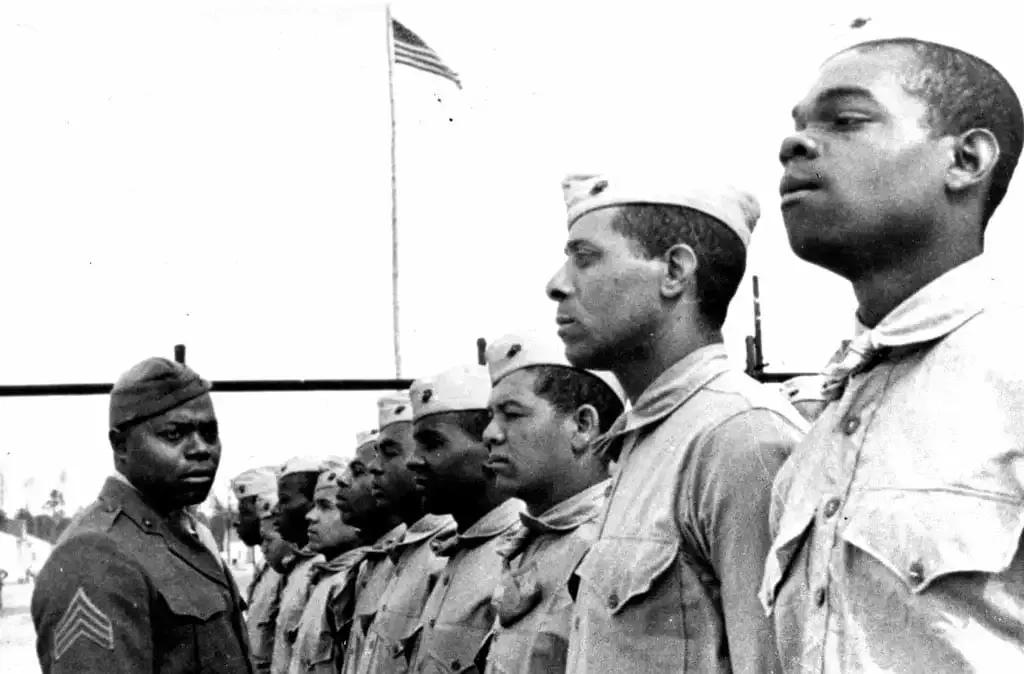
On August 26, 1942, a group of African American men arrived at Montford Point, a remote, undeveloped corner of Camp Lejeune surrounded by swamp and forest. They were the first Black recruits in the history of the United States Marine Corps — and they were not welcome.
Executive Order 8802
The desegregation of the military began not with an act of conscience, but with political pressure. In June 1941, civil rights leader A. Philip Randolph threatened to organize a march on Washington to protest racial discrimination in the defense industry and armed forces. To prevent the march, President Franklin D. Roosevelt signed Executive Order 8802, prohibiting discrimination in the defense industry. Under subsequent pressure, the Marine Corps — the last branch to accept Black recruits — reluctantly began accepting African American enlistees in 1942.
Montford Point
Rather than integrate Black recruits into existing training facilities, the Marine Corps established a separate, segregated camp at Montford Point, a swampy area at the eastern edge of Camp Lejeune. The facilities were primitive — hastily built wooden barracks, unpaved roads, and limited training equipment. The first recruits found conditions far worse than those at the main Camp Lejeune facilities where white Marines trained.
Proving Ground
Despite the hostility and hardship, the Montford Point Marines excelled. They endured the same grueling physical training as their white counterparts and consistently met or exceeded standards. Many served in combat roles during World War II, including the Battle of Saipan, the Battle of Peleliu, and the Battle of Iwo Jima, where they worked as ammunition carriers, anti-aircraft gunners, and in other essential roles under fire.
The Numbers
Between 1942 and 1949, approximately 20,000 African American Marines trained at Montford Point. They served in every theater of World War II and in the Korean War. In 1949, President Harry Truman's Executive Order 9981 mandated the desegregation of the armed forces, and Montford Point was eventually closed as a segregated facility. The recruits were integrated into the broader Marine Corps.
Recognition Long Overdue
For decades, the Montford Point Marines received little recognition for their service and sacrifice. That changed in 2012, when the surviving Montford Point Marines — and their families — were collectively awarded the Congressional Gold Medal, the highest civilian honor bestowed by Congress. The ceremony at the U.S. Capitol honored the approximately 400 surviving members of the original 20,000.
Today, Montford Point is home to the 4th Marine Logistics Group headquarters, and the Montford Point Marine Museum preserves the history of these pioneering servicemembers. A memorial stands at the site, ensuring that the courage of those first Black Marines is never forgotten.
Their story is not just military history — it is a chapter of the American civil rights movement, written in the swamps and training fields of Onslow County.